


The request to see “how their people are doing” is a common one for executive directors, education directors, and program managers at professional associations and continuing-education providers. Effectively managing direct reports in Moodle requires more than just assigning a role; it demands a clear strategy for data ownership, visibility, and privacy. Saying yes casually can expose member data and the trust that comes with it.
This article explores the strategic decisions required to establish and maintain manager-to-learner relationships in Moodle, focusing on membership-based associations and the providers behind continuing education management strategies in Moodle.
I recently migrated my site to Mindfield from another host, and the experience couldn’t have been better. Mindfield kept working until they were certain that my site was operating as well as it was before, and they even helped clean up a few issues to improve my site’s performance – issues my prior host never mentioned. I also found Mindfield’s communication to be excellent. Before the migration, they prepared me for what to expect, and during the migration they kept me well-informed.
Jim Benedek
review Source: Google Reviews
Outline
- Where the Reporting Structure Actually Lives, And Why Every Other Decision Follows From It
- What Moodle Core Actually Gives You, And The Exact Point Where It Stops
- When You Have Outgrown Core, And The Trigger That Tells You
- When “Manager” Is Not An Employer, The Mistake That Costs The Most
- What A Manager Should See, And What They Should Not, Deciding The Line On Purpose
- How Moodle@Work Adds a Real Reporting Line to Standard Moodle
- Mindfield’s Strategic Approach to Manager Relationships
- Frequently Asked Questions (FAQs)
Where the Reporting Structure Actually Lives: And Why Every Other Decision Follows From It

The fundamental question for establishing manager-to-learner relationships in Moodle is not how to configure the platform itself. Instead, it is about identifying which system holds the authoritative record for these relationships. That decision sets how accurate the data stays over time.
Identifying the System of Record for Relationships
The system of record for direct report relationships dictates how changes are managed and propagated. That decision is Moodle user provisioning and choosing the system of record. The record holds a link between two people, not the people themselves. For associations, this typically falls into several categories.
- Association Management System (AMS) or Customer Relationship Management (CRM) System: When your AMS or CRM owns the reporting structure, Moodle acts as a mirror. Relationship changes, such as a member leaving a chapter board, are updated in the AMS/CRM first. These updates then flow into Moodle through an integration. This approach ensures that a manager’s view is automatically revoked on the next synchronization if their role changes. Mindfield has extensive experience with optimizing user experience for integrating Moodle with CRMs.
- Moodle Itself: Maintaining relationships directly within Moodle means someone in your association is responsible for ongoing manual updates. This can be a defensible choice for small-scale operations with few relationships and infrequent changes. However, it requires a named individual to own the maintenance process indefinitely.
- An Employer’s Human Resources (HR) System: If an external employer’s HR system is the source, your association consumes data you do not control. This means an employer’s internal reorganizations become your data management challenge. You also lose the ability to audit the source data directly.
- A Membership Coordinator’s Spreadsheet: A spreadsheet is a defensible stopgap, but it scales badly and has no mechanism for removal at all.
The Critical Role of Relationship Removal
Stale manager relationships are the common failure. People change employers or finish their terms, and if their view in Moodle quietly outlives the reason for its existence, it creates a lingering data exposure risk.
The system that owns the relationship structure must also own the removal process. This ensures that views are terminated promptly when the underlying relationship ends.
What Moodle Core Actually Gives You, And The Exact Point Where It Stops

Many assume Moodle core includes a reporting hierarchy. It does not: its manager link is real, but flat.
The “Assign Roles Relative to This User” Mechanism
In Moodle, a manager-to-person link is created by assigning a role to one user within another user’s specific user context. The Moodle interface labels this screen as “Assign roles relative to this user.” This is the entire core mechanism for establishing such a connection.
Limitations of the Mentees Block and Core Reporting
Moodle core includes a “Mentees” block to display these direct relationships. Three limits define what it can actually tell a manager:
- One level, no roll-up: the block lists only the users the viewer holds a direct role assignment over. A regional director sees the people attached to them personally, never the members of the chapters beneath them.
- No role holds the reporting capability: core defines a user-level capability for viewing another user’s activity reports. Its own source code describes it as designed for a parent role and not used in the legacy roles. No role is granted it by default.
- No report is scoped to your people: every standard core report is scoped to a course or to the whole site. None of them takes “the people who report to me” as its scope.
In other words, the relationship was anticipated and then left for each site to assemble. That gap is what organizations hit when they call Moodle’s manager reporting insufficient, and it sits close to why Moodle roles and permissions stop working.
Roles, Contexts, and Cohorts for Visibility, Not Hierarchy
Moodle’s roles, contexts and cohorts grant a manager scoped visibility. They do not model an organizational tree. Cohorts are the clearest example:
- They are site-wide or category-wide groups.
- They define membership, such as “these forty people work for that employer.”
- They cannot say who among those members reports to whom, and there is no parent cohort.
Moodle core is therefore sufficient when a manager needs a named, flat list of people. It stops being enough the moment anyone needs a total that rolls up.
When You Have Outgrown Core: And The Trigger That Tells You

Outgrowing core’s flat model is a strategic call, not a feature comparison, and the trigger is usually scale.
Key Triggers for Outgrowing Core
Two primary numbers help decide if you have outgrown Moodle core:
- How many managers: A dozen sponsoring employers whose contact people change once a year can be managed with core Moodle and a clear process. However, two hundred chapter administrators with an annual election cycle is a different challenge.
- How often the structure changes: Infrequent changes are manageable manually. Rapidly evolving structures quickly overwhelm manual processes within Moodle core.
A third critical trigger is whether anyone needs a number that adds up across levels. The moment your board or a program sponsor requests completion rates by region, for example, Moodle’s flat model is finished.
Platforms Offering True Hierarchical Structures
Three platforms model a real hierarchy rather than a list of relationships:
- Moodle Workplace: This solution models an organization with department frameworks, position frameworks, and job assignments. It is licensed software sold only through Moodle’s certified partners. If you are weighing it, explore alternatives to Moodle Workplace and understand the differences between Moodle and Moodle Workplace.
- IOMAD: IOMAD organizes learning around tenants with hierarchical divisions. Its tenant managers can run users, enrolments and reporting for their own part of the hierarchy. More details on how user management works in IOMAD are available.
- Totara: Totara allows organizations to build multiple frameworks representing their structure, covering job positions and organizational sections. A user’s manager is established through their job assignment. Significantly, a user can hold more than one job assignment, which is highly relevant for learners who might have both an employer and a chapter affiliation.
Each of these is a platform change that shapes upgrades, hosting and support for years. Many associations reach for one when a clearer answer to the ownership question would have solved the problem. A fourth route keeps standard Moodle entirely: the Moodle@Work theme, covered below.
When “Manager” Is Not An Employer: The Mistake That Costs The Most
A common and expensive mistake for associations and continuing education providers is importing a corporate organizational chart mindset into an environment that lacks one. Here, the “manager” is rarely a permanent employer.
Diverse Manager-Like Relationships in Associations
Five relationships need oversight, and each one changes what managing direct reports in Moodle means.
- The Chapter or Branch Administrator: Often a volunteer, typically elected, and serving a fixed term. This individual needs to see which members of their chapter are current on required learning. The end of their term must remove their view, a cycle Moodle does not track.
- The Sponsoring Employer: An entity that has paid for a block of seats in a course or program. Their interest is whether the seats were used and the training completed, for as long as the sponsorship runs. This view is often over-scoped by accident.
- The Program or Cohort Coordinator: Often an association staff member, whose oversight is scoped to a specific intake or program. The relationship ends with the cohort, and it is the easiest one to leave running by mistake.
- The Preceptor, Supervisor, or Mentor of Record: This person signs off on practical hours or supervised practice, often for licensure or designation requirements. They genuinely need individual detail, but their relationship is per-member, time-bounded, and specific to one requirement. A permanent manager link is the wrong shape for it.
- The Employer’s Own Training Lead: When a member’s employer wants association learning data in its own compliance program, that is a data-sharing agreement, not a Moodle role.
Designing for Temporary and Overlapping Relationships
These relationships share three properties that an organizational chart does not handle:
- Temporary: a term ends, a sponsorship lapses, a cohort closes.
- Overlapping: one member can be a chapter administrator, a preceptor and a sponsored learner at the same time.
- Not employment: nobody in the chain can direct anyone else’s work.
An org chart assumes one permanent parent per person, so modelling these as a chart is wrong within a year. Instead, model every relationship with a defined end, and decide upfront what event terminates it. If no one can name the event that removes the manager’s view, that relationship should not be created at all.
What A Manager Should See, And What They Should Not: Deciding The Line On Purpose

What a manager can see is a privacy decision before it is a settings one.
A Defensible Default When Managing Direct Reports in Moodle
The guiding principle should be that completion status is generally reasonable for a manager to see, while a member’s individual answers, failed attempts, or personal forum posts are usually not. A defensible default for manager visibility includes:
- Whether a requirement is met.
- When it was met.
- When it expires.
Conversely, managers should not see attempt history, individual question responses, forum posts written in a learning context, or anything from courses outside the direct scope of their relationship.
The Coarse Granularity of Moodle’s Controls
Two technical facts set how far a manager’s view actually reaches:
- Grades are all or nothing: the capability that exposes a learner’s grades is declared at both course and user level. Granted through a manager-to-person relationship, it exposes that learner’s grades across every course they are enrolled in. There is no per-course dial.
- Quiz detail is out of reach: the capabilities for viewing quiz reports and grading attempts are declared at activity level only. They cannot take effect through a user-context role assignment. Reaching them means making the manager course staff for everyone in that course.
The boundary therefore has to be decided by what you choose to grant. Ultimately, the system will not draw a fine line on your behalf.
Strategic Reporting Versus Direct Access
Given these technical realities, many associations achieve a better result by reporting completion data out to the manager on a scheduled basis, rather than giving the manager direct access to Moodle. A custom report answers the sponsor’s actual question without standing access, which is narrower than any role.
Consider scheduling Moodle custom reports or sending Moodle reports automatically to provide this information. For examples of what these reports can look like, refer to Moodle student engagement report examples.
Transparency and Data Retention
Associations must also handle the member-facing half of this, which is the part most of them skip. Two commitments cover it:
- Tell members who can see their progress, and on what basis. One line in your membership terms prevents the complaint that damages trust.
- Treat the relationship as a retention decision. A manager’s view is a copy of someone’s learning record in another person’s hands, so how long it lasts is not only a permissions question.
Finally, plan it alongside your Moodle data retention strategies for professional associations.
How Moodle@Work Adds a Real Reporting Line to Standard Moodle
Mindfield built the Moodle@Work theme for the gap this article keeps returning to. It gives a regular Moodle site the reporting structure that usually means buying a licensed LMS or rebuilding on multi-tenancy, and it runs on standard Moodle core, so your upgrade path does not change.
One Owner for Every Relationship
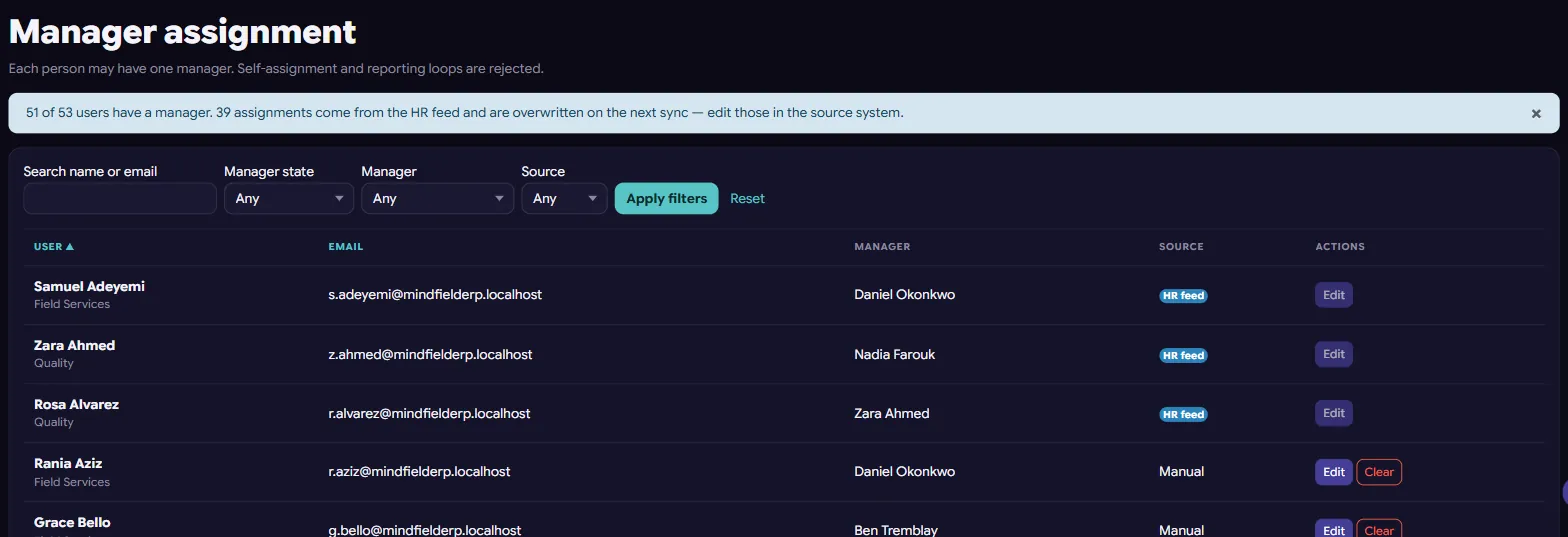
Each person can have one manager, and the system rejects self-assignment and reporting loops. Every link shows its source:
- HR feed: locked on screen, because the next sync would overwrite a local edit. You change it in the source system, so the system of record is enforced by the software, not a policy document.
- Manual: set by an administrator where no feed applies.
Meanwhile, bulk changes arrive as a comma-separated values (CSV) import. People are matched on the identification number in their profile, each row is applied on its own, and a file can be validated before anything is written. A blank manager column clears the link, so removal travels the same route as creation.
Totals That Roll Up
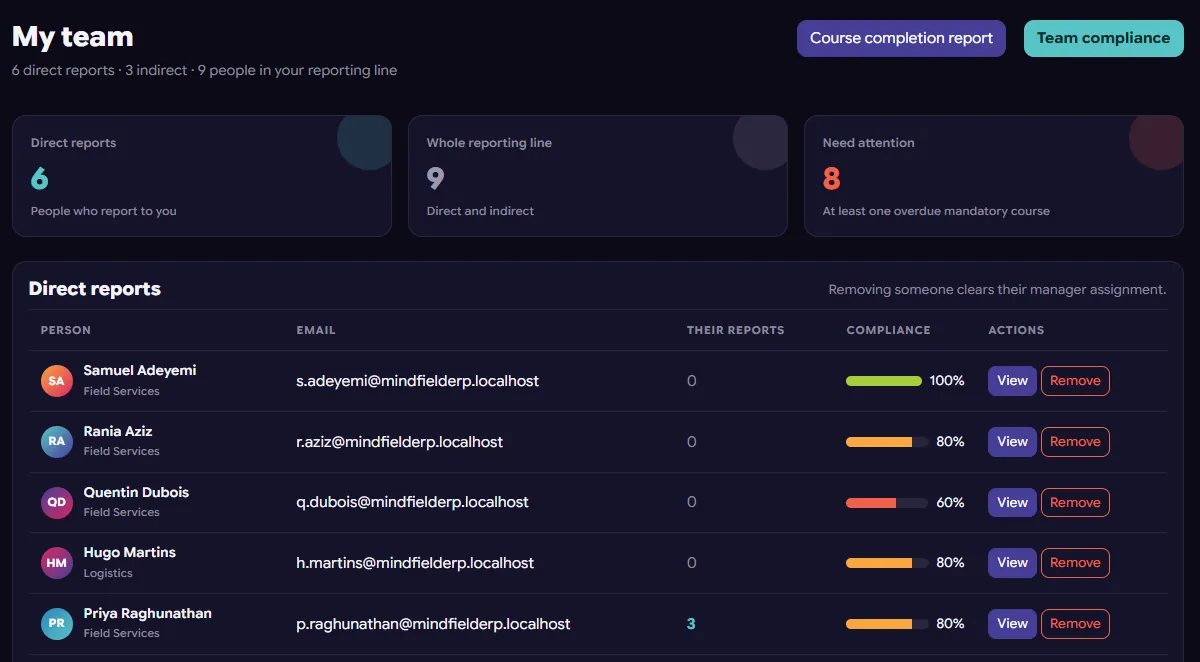
A manager’s team view counts direct reports, indirect reports and the whole reporting line, and flags everyone with at least one overdue mandatory course. That is the number that ends core’s flat model.
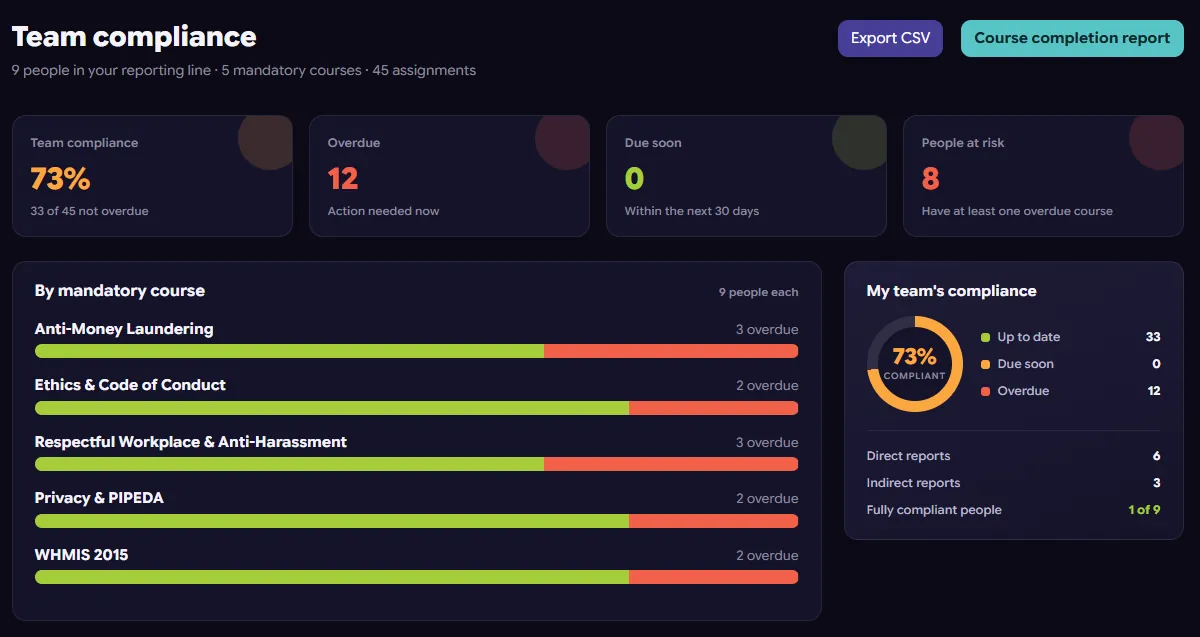
The team compliance view breaks it down by mandatory course, names the people at risk, switches between direct reports and the whole line, and exports a file a board or sponsor can read.
A View Built Around Status
What a manager sees is status: up to date, due soon, overdue, and the next item due for each person. That matches the defensible default above. However, one manager per person fits a chapter or employer structure, so a preceptor or mentor of record still belongs in a time-bound relationship of its own.
Mindfield’s Strategic Approach to Manager Relationships

Our team works with professional associations and continuing education providers on the decisions that managing direct reports in Moodle turns on: which system owns the relationship, what event ends it, and where the visibility line falls. Where core stops short, Moodle@Work closes the gap without a licence or a rebuild. Talk to us while you are still designing the roles, rather than after someone has seen a record they should not have.
Frequently Asked Questions (FAQs)
This article may contain conceptual illustrations to help support the article content.
