


Professional associations often face a unique challenge. That is, candidates must achieve an overall passing score and demonstrate proficiency in specific, critical areas. This means effectively enforcing a Moodle quiz pass mark per section. However, this capability is not natively available in Moodle’s standard quiz module. While Moodle excels at aggregating scores, its default behavior does not easily support granular, competency-based minimums within a single assessment.
Therefore, this limitation can pose significant compliance risks when certifying individuals who must meet strict competency standards. This article will explore why Moodle lacks this native functionality. Also, it covers strategically deciding strict exam domain minimums and the trade-offs of implementing section-based scoring. Furthermore, we will also discuss the impact of these strategies on Moodle continuing education credit records and how Mindfield Consulting develops custom solutions to meet these precise requirements.
My interaction with Mindfield was extremely professional. They went above and beyond when assisting me. I am very grateful for the opportunity and I would highly recommend to anyone.
Mc Andrew Rambharose
review Source: Google Reviews
Outline
- Moodle’s Native Quiz Limitations and Compliance Risks
- Strategic Decision-Making for Competency-Based Scoring
- Comparing Quiz Structures: Separate Exams vs. Integrated Sections
- Impact on Continuing Education Records and Certification Transcripts
- Custom Grading Logic for Sectional Pass Marks
- Enhancing Certification Exams with Expert Moodle Development
- Frequently Asked Questions (FAQs)
Moodle’s Native Quiz Limitations and Compliance Risks

Moodle’s quiz module is robust for general assessment, but it primarily calculates a single, aggregate score for the entire quiz. As a result, this design choice simplifies grading for broad knowledge assessments. However, it does not offer built-in functionality for setting a minimum pass mark. So, specific question categories or sections within that single quiz lack this feature.
However, this limitation becomes a significant concern for professional associations that need to certify granular competencies.
Why Moodle Lacks Per-Question Minimums
For example, Moodle’s core philosophy prioritizes flexibility and aggregation. That is, its gradebook is designed to collect scores from various activities and combine them into a final course grade. While you can organize categories, Moodle question bank issues arise because independent pass/fail logic isn’t natively applied to internal groupings.
This means a learner could score perfectly on easy questions but perform poorly on critical competency questions. Still, they might achieve an overall passing grade. Consequently, the system would certify them as competent, even if they failed a core skill area.
Compliance Risks for Professional Associations
Because of this, certifying candidates who have not met specific minimum standards in critical areas carries substantial compliance risks. Also, professional associations are often governed by regulatory bodies and accreditation standards that demand demonstrable competence in all essential domains. Failing to enforce these granular requirements can lead to severe consequences:
- Reputational Damage: Certifying unqualified individuals can erode public trust in the association’s credentials. This directly impacts the value of the certification.
- Legal and Ethical Liabilities: If a certified professional causes harm due to a lack of a critical competency, the association may face legal action. Furthermore, it could also face ethical scrutiny.
- Accreditation Loss: Non-compliance with specific assessment criteria can result in the loss of accreditation. This invalidates the entire certification program.
- Inaccurate Competency Reporting: Without granular data, it is impossible to accurately report on a candidate’s proficiency across all required skill sets. This undermines the purpose of competency-based exams.
Therefore, addressing this native Moodle limitation is not merely a feature request. Also, it is a critical safeguard for professional integrity and public safety.
Strategic Decision-Making for Enforcing Moodle Quiz Pass Mark Per Section

Deciding which exam domains require strict minimum scores is a strategic process. Also, this applies to areas where aggregate averaging meets professional association standards. This decision should align with the core competencies the certification aims to validate. It requires a clear understanding of the professional role and its associated risks.
Categorizing Competencies: Critical vs. Supplementary
The first step involves a detailed review of the certification’s learning objectives and the professional practice it represents. Competencies can generally be categorized based on their importance and the impact of failure:
- Critical Competencies: These are fundamental skills or knowledge areas where a deficiency could lead to significant harm, legal violations, or direct professional malpractice. Examples include safety protocols in engineering, diagnostic accuracy in healthcare, or ethical guidelines in finance. These domains unequivocally require a strict minimum pass mark.
- Supplementary Competencies: These areas enhance professional practice but are not individually catastrophic if a candidate struggles slightly. General knowledge of industry history, common terminology, or less frequently applied procedures might fall into this category. Performance here can often be averaged into the overall score.
This distinction helps in allocating assessment rigor appropriately. It ensures that critical skills are never overlooked due to a high score in less vital areas.
Risk Assessment for Exam Domains
A formal risk assessment for each exam domain further refines the scoring strategy. Consider the potential consequences if a certified professional lacks proficiency in a specific area. High-risk domains necessitate minimum pass thresholds.
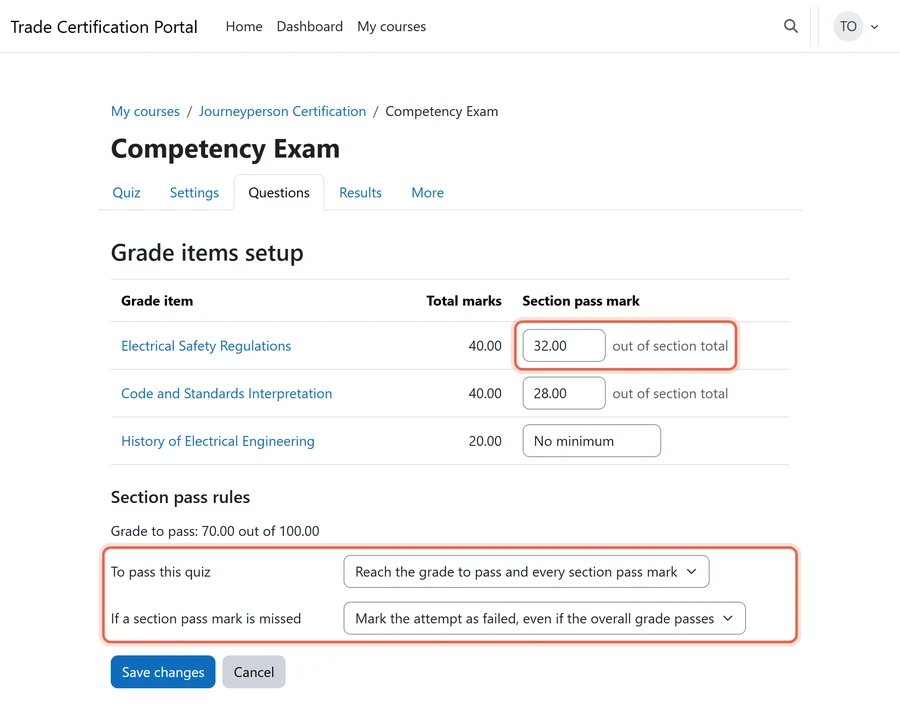
Meanwhile, lower-risk areas can tolerate a broader range of performance if compensated by strength elsewhere. For example, a professional association for electricians might identify “Electrical Safety Regulations” as a critical domain. Failing this section, even with a high overall quiz score, would prevent certification.
Conversely, “History of Electrical Engineering” might be a supplementary domain. A lower score here would not necessarily impede certification if overall competence is demonstrated.
Developing a Decision Framework for Enforcing Moodle Quiz Pass Mark Per Section
Professional associations should develop a clear decision framework. This framework guides the application of minimum scores. This framework should consider several factors:
- Regulatory Requirements: Are there external mandates dictating minimum performance in specific areas?
- Professional Standards: What does the profession itself deem essential for safe and effective practice?
- Stakeholder Input: Gather feedback from experienced practitioners, educators, and regulatory bodies.
- Test Blueprint Alignment: Ensure the scoring strategy directly reflects the exam’s blueprint. The blueprint details the weighting and importance of each content area.
This methodical approach ensures that the decision to enforce a Moodle quiz pass mark per section is well-justified and defensible. It also supports the integrity of the certification.
Comparing Quiz Structures: Separate Exams vs. Integrated Sections

When facing Moodle’s native limitations, professional associations often consider two primary structural approaches. That is, splitting competencies into separate quizzes or applying complex section rules within one comprehensive exam. Both have distinct trade-offs impacting learner experience, administration, and reporting.
Splitting Competencies into Separate Quizzes
This approach involves creating multiple, distinct Moodle quizzes, each focusing on a specific competency domain. Each quiz can then have its own pass mark. This is a straightforward method within Moodle’s native capabilities.
- Pros:
- Simplicity for Moodle Administrators: Setting up individual pass marks for separate quizzes is standard Moodle functionality.
- Clear Feedback for Learners: Learners immediately know if they passed or failed a specific competency area. This allows targeted remediation.
- Native Moodle Reporting: Each quiz’s pass/fail status is easily trackable in the Moodle gradebook.
- Cons:
- Fragmented Learner Experience: Taking multiple short quizzes can feel disjointed and less like a single, comprehensive certification exam.
- Increased Administrative Overhead: Managing enrollment, attempts, and settings across many quizzes can be cumbersome for large cohorts.
- Reporting Fragmentation: Aggregating results from multiple quizzes into a single, cohesive certification transcript requires custom reporting. This often needs manual compilation.
- Logistical Challenges: Scheduling and proctoring multiple quizzes can be more complex than a single exam.
Applying Complex Section Rules Within One Exam
This strategy involves keeping all competencies within a single Moodle quiz. However, it requires implementing custom logic to enforce pass marks on internal sections. This approach requires development outside of Moodle’s default features.
- Pros:
- Integrated Learner Experience: The exam feels like a single, cohesive assessment, mirroring real-world certification exams.
- Holistic View of Performance: All results are contained within one quiz record. This simplifies data collection, though not necessarily interpretation.
- Reduced Administrative Burden: Only one activity needs setup, enrollment, and management.
- Cons:
- Moodle Limitations: This requires custom development because Moodle does not natively support per-section pass marks.
- Development Complexity: Implementing custom grading logic is a significant undertaking. It requires Moodle development expertise.
- Maintenance and Upgrade Challenges: Custom code needs careful maintenance and compatibility checks with Moodle upgrades.
- Potential for Data Overload: While all data is in one place, extracting granular section pass/fail status can still require custom reporting.
Comparison of Quiz Structures for Enforcing Moodle Quiz Pass Mark Per Section
| Feature | Separate Quizzes | Single Quiz with Custom Section Rules |
|---|---|---|
| Learner Experience | Fragmented | Integrated |
| Moodle Native Support | High | Low (requires custom development) |
| Administrative Overhead | Higher (multiple activities) | Lower (single activity) |
| Grading Complexity | Low (per quiz) | High (custom logic) |
| Reporting Granularity | Basic (per quiz) | Requires custom extraction |
| Development Cost | Low (configuration) | High (custom coding) |
The choice hinges on balancing administrative ease, learner experience, and the resources available for custom development. Organizations with strong compliance needs and a desire for a seamless learner experience have options. So, investing in custom development for a single quiz structure is often the preferred route.
Impact on Continuing Education Records and Certification Transcripts

The method chosen for enforcing a Moodle quiz pass mark per section has direct impacts. Because of this, it affects how continuing education (CE) credit records and final certification transcripts are generated and interpreted. Standard Moodle reporting tools might not adequately capture the nuanced outcomes of competency-based assessments. So, this necessitates careful planning for data extraction and integration.
Moodle’s Gradebook and CE Credit Reporting
Moodle’s gradebook is designed to display and calculate grades for activities and courses. When using separate quizzes for each competency, each quiz’s grade appears as a distinct item. This makes it clear which specific areas a learner has passed or failed.
A professional association might need a single CE credit for the entire certification. However, manually combining these results can be labor-intensive. Conversely, a single quiz with custom section logic will only show one overall grade in the Moodle gradebook. The internal pass/fail status of individual sections is not visible by default.
This requires custom reporting to extract the granular data needed for CE credit validation. This also ensures full compliance.
Ensuring Accuracy for External Systems
Professional associations frequently integrate Moodle with external systems. For example, they use an Association Management System (AMS) or Customer Relationship Management (CRM) platform. These systems are often the authoritative source for certification status and CE records. The challenge lies in transmitting the correct level of detail from Moodle.
When using separate quizzes, the pass/fail status of each quiz can be pushed to the external system. This provides clear, discrete records. However, this might create many individual records for a single certification.
With a single quiz and custom logic, the overall quiz pass/fail can be sent. However, the detailed section results require a custom integration. This custom integration provides the specific data points needed for compliance and auditing.
Audit Trails and Data Integrity
Maintaining robust audit trails and Moodle data retention strategies is paramount for professional associations. These trails demonstrate that certification decisions are based on verifiable, granular data.
- Separate Quizzes: Each quiz maintains its own set of attempts and grade history. This makes auditing individual competency passes relatively straightforward. However, linking all these separate records to a single certification event requires a consolidated view, which Moodle does not provide out-of-the-box.
- Single Quiz with Custom Logic: The custom logic must meticulously log the pass/fail status of each section. This ensures data integrity. These logs should be accessible for auditing purposes. The overall quiz attempt and grade are recorded, but the custom logic’s output is critical for validating competence.
Regardless of the chosen structure, the strategy must prioritize data accuracy and integrity. This ensures that continuing education credits and certification transcripts precisely reflect a candidate’s demonstrated competencies. It also safeguards the association’s reputation.
Custom Grading Logic for Enforcing Moodle Quiz Pass Mark Per Section

Moodle lacks native functionality for per-question or per-section pass marks within a single quiz. As a result, professional associations often turn to custom development. Mindfield Consulting specializes in building tailored grading logic that enforces these specific rules. Also, this avoids requiring a complete restructuring of your existing certification exams.
Leveraging Moodle’s Extensibility for Enforcing Moodle Quiz Pass Mark Per Section
Moodle is an open-source Learning Management System (LMS) with a highly extensible architecture. This allows developers to create potential Moodle plugins or modify existing behaviors. This is done without altering core code, which is crucial for your Moodle maintenance strategy.
Our approach typically involves using one or more of Moodle’s extension points:
- Local Plugins: These allow the injection of custom code and functionality specific to your Moodle site. A local plugin can override default quiz grading processes.
- Event Observers: Moodle’s event API allows custom code to “listen” for specific actions, such as a quiz attempt being submitted or graded. This provides a hook to apply custom logic immediately after Moodle’s standard grading.
- Custom Quiz Reports: While not directly enforcing pass marks, custom reports can analyze quiz attempt data. This allows reporting on section-specific performance and flagging failures.
These mechanisms enable the implementation of complex rules. This includes rules like “pass all sections with a high score” or “pass section A with a strict threshold and section B with a moderate score.”
Strategy for Integrating Custom Grading Logic When Enforcing Moodle Quiz Pass Mark Per Section
Implementing custom grading logic requires a clear strategy to ensure seamless integration and long-term stability. Our process focuses on:
- Defining Rules Precisely: First, we work with the association to precisely define all section-specific pass mark rules. This includes any weighting or conditional logic.
- Intercepting Quiz Submissions: We develop an event observer that triggers when a quiz attempt is submitted or graded. This allows us to access the raw question responses and Moodle’s initial grading data.
- Applying Custom Calculations: Our custom code then takes the raw scores for each question category (section). It applies the defined pass mark rules to each section independently.
- Modifying Final Grade/Status: Based on the custom calculations, the system can override the overall quiz grade or mark the attempt as failed, even if the aggregate score is high. It can also provide specific feedback to the learner.
- Logging Granular Results: Crucially, the custom logic also logs the pass/fail status for each section. This ensures a comprehensive audit trail for compliance and reporting.
This strategic approach ensures that the custom solution is robust, scalable, and fully integrated with your Moodle environment.
Key Considerations for Custom Development
While custom development offers powerful solutions, it comes with important considerations:
- Scalability: The custom logic must handle large numbers of users and quiz attempts without impacting Moodle’s performance.
- Maintainability: Code must be clean, well-documented, and adhere to Moodle’s coding standards. This ensures future updates and bug fixes are manageable.
- Upgrade Compatibility: The custom solution must be designed to be forward-compatible with future Moodle versions. This minimizes rework during upgrades.
- Security: Custom code must follow best practices for security. This prevents vulnerabilities and protects sensitive learner data.
By addressing these points, Mindfield Consulting ensures that custom grading solutions are not just functional but also reliable and sustainable. This allows professional associations to confidently enforce Moodle quiz pass mark per section requirements.
Enhancing Certification Exams with Expert Moodle Development

Implementing advanced, competency-based assessment logic within Moodle presents a complex technical challenge. While the platform offers immense flexibility, configuring it to enforce granular pass marks per section requires specialized knowledge beyond standard administration. Professional associations often need to balance rigorous compliance standards with a seamless learner experience.
This is where expert development and comprehensive Moodle support become invaluable. Mindfield Consulting’s Moodle specialists can design, develop, and deploy custom solutions that precisely meet your certification requirements. We ensure your assessments are robust, compliant, and integrated, without disrupting your existing Moodle environment.
Frequently Asked Questions (FAQs)
This article may contain conceptual illustrations to help support the article content.
