

Organizations that rely on Moodle to deliver learning, assessments, or customer training are increasingly asked an important question by customers, auditors, and enterprise buyers.
Are you SOC 1 or SOC 2 compliant?
As Moodle platforms become more integrated with financial systems, identity providers, and customer data, compliance expectations increase. This article explains what companies should know when considering SOC 1 (Service Organization Control 1) and SOC 2 (Service Organization Control 2) compliance for Moodle, when it is required, what it involves, common challenges, and how expert Moodle support helps reduce risk.
To say that Mindfield Consulting is Planet SHIFT Inc.’s key strategic technology partner is an understatement. They play a pivotal role in helping us delight our clients, providing valuable guidance, forefront thinking, and creative, sustainable solutions — simply – honest and excellent work. As a change agent, I rely on my Mindfield partnership to unlock the possible, and for just under a decade I have never been disappointed. Our clients’ projects range in complexity and criticality, and the credibility of my company’s brand accelerates when Mindfield is included in the assignment. We reinvent businesses together.
Eileen Kirk
review Source: Google Reviews
Outline
-
-
What are SOC 1 and SOC 2?
-
When do organizations need SOC compliance for Moodle?
-
How SOC 1 and SOC 2 relate to Moodle core by version
-
Practical technical examples for SOC controls in Moodle
-
Hosting and shared responsibility in SOC Compliance
-
SOC readiness checklist for Moodle
-
How Moodle experts help you achieve SOC 1 and SOC 2 compliance
-
Frequently asked questions (FAQs)
-
What are SOC 1 and SOC 2?
SOC reports are independent audit reports governed by the AICPA (American Institute of Certified Public Accountants). They evaluate how service organizations manage risk and protect systems and data.
SOC 1
SOC 1 focuses on controls over financial reporting.
SOC 1 applies when a Moodle platform:
- Supports billing or invoicing workflows
- Tracks learning activity tied to revenue recognition
- Integrates with accounting or ERP systems
- Is used by customers subject to financial audits
SOC 2
SOC 2 focuses on operational and data security controls based on Trust Services Criteria.
- Security
- Availability
- Confidentiality
- Processing Integrity
- Privacy
SOC 2 is the most common requirement for Moodle platforms delivered as managed or hosted services. This does not mean every Moodle deployment needs SOC 2. It is typically requested when organizations provide Moodle as a hosted service to customers, store sensitive user data, or undergo enterprise vendor security reviews. Internal training platforms used only within one organization usually do not require SOC 2 unless a client, regulator, or contractual agreement specifies it.
When do organizations need SOC compliance for Moodle?
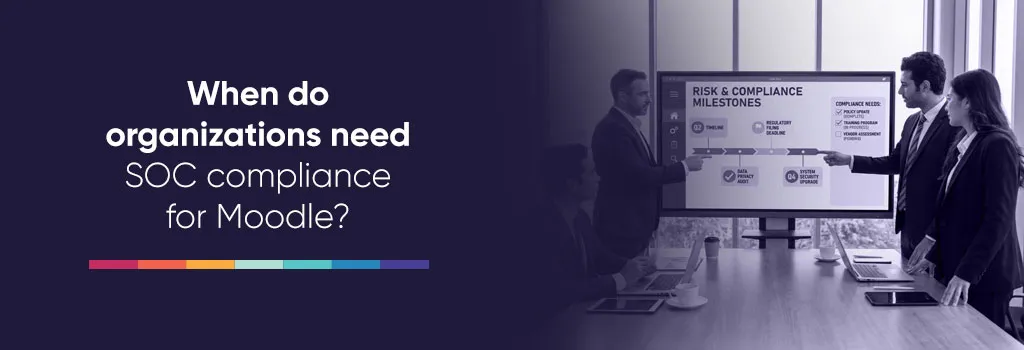
Organizations typically pursue SOC compliance when:
- Enterprise customers require it during vendor reviews
- Enterprise security questionnaires become more frequent and time-consuming during procurement reviews, slowing down sales when formal assurance like SOC 2 is not available.
- The platform serves regulated industries
- Moodle becomes business critical infrastructure
- Investor or audit expectations increase
If customers request SOC reports or formal control documentation, SOC readiness becomes necessary.
How SOC 1 and SOC 2 relate to Moodle core by version
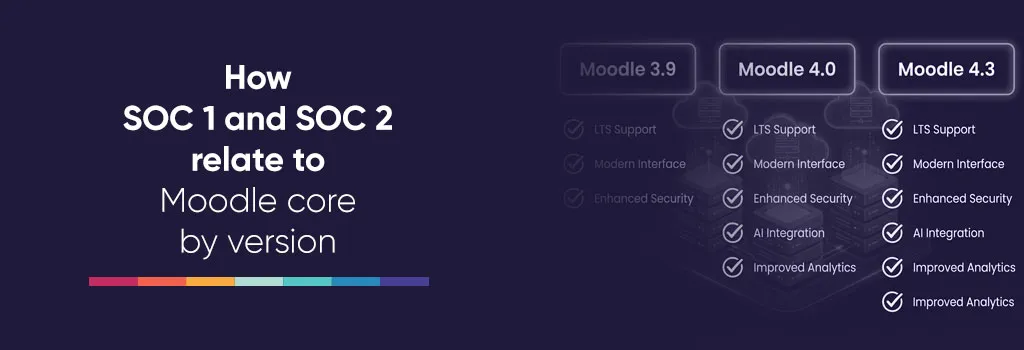
Moodle itself is not SOC 1 or SOC 2 compliant. SOC compliance applies to how an organization operates, secures, and manages the platform.
Moodle core provides technical capabilities that support SOC controls. These capabilities improve by version.
| Moodle Version | SOC-Aligned Capabilities in Moodle Core | Key Limitations and Considerations |
|---|---|---|
| 3.9 to 3.11 |
|
|
| 4.0 to 4.2 |
|
|
| 4.3 and later |
|
|
Across all versions, SOC compliance depends on documented processes, monitoring, and evidence collection beyond Moodle core.
Practical technical examples for SOC controls in Moodle
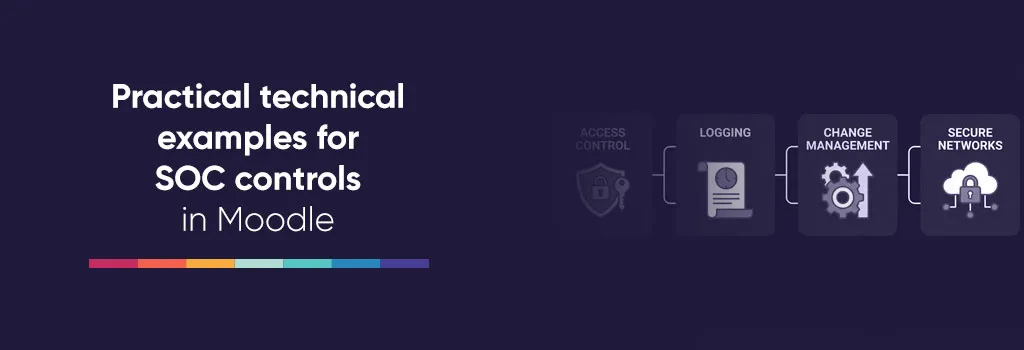
Access Control Example
SOC expectation: Only authorized users have administrative access.
Moodle implementation:
- Separate roles for administrators and support staff
- Restrict site administration access
- Enforce single sign-on with multi-factor authentication
Audit evidence: Role definitions, access lists, access reviews.
Change Management Example
SOC expectation: System changes are approved, tested, and documented.
Moodle implementation:
- Use staging environments
- Test updates and plugins before release
- Document deployment approvals
Audit evidence: Change logs and deployment records.
Logging and Monitoring Example
SOC expectation: Security events are logged and reviewed.
Moodle implementation:
- Enable standard and legacy logs
- Define log retention periods
- Review authentication and admin events
Hosting and shared responsibility in SOC compliance
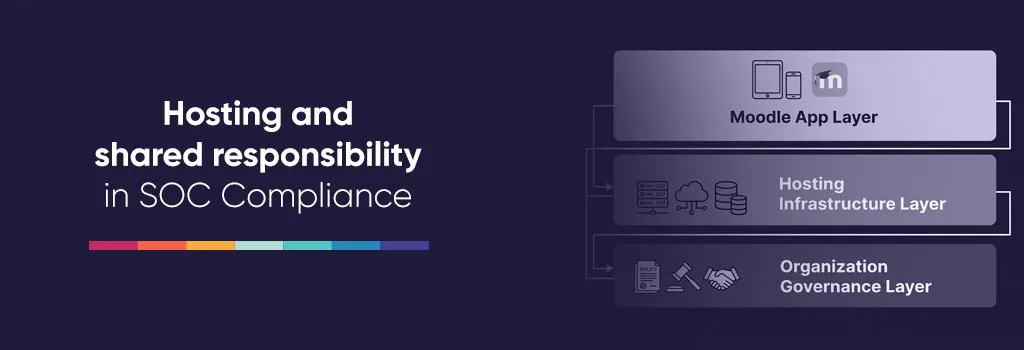
SOC audits evaluate the full service delivery model.
Moodle Core
- User roles and permissions
- Audit logging
- Privacy and data controls
Hosting and Infrastructure
- Infrastructure security
- Network protection
- Disaster recovery
Client Organization
- Access approvals
- Change governance
- Incident response
SOC readiness checklist for Moodle
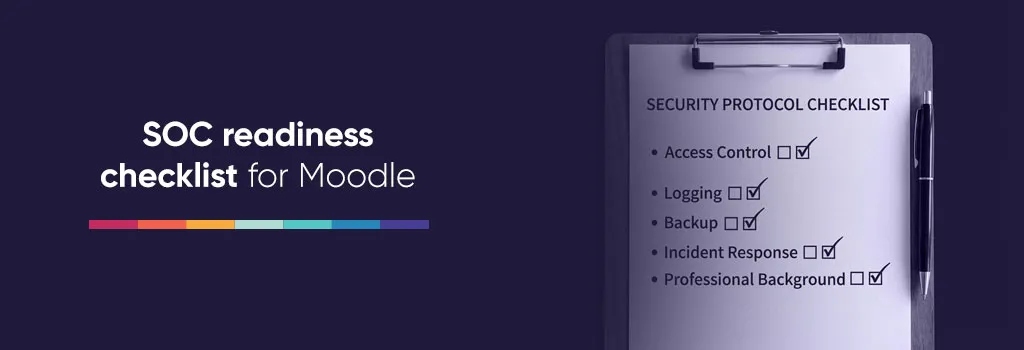
- Defined audit scope
- Documented access policies
- Formal change management
- Centralized logging
- Backup and recovery testing
- Incident response procedures
- Plugin and vendor risk reviews
How Moodle experts achieve SOC 1 and SOC 2 compliance
As a provider of Moodle support and development services, we help organizations build audit-ready Moodle platforms.
- SOC readiness assessments
- Moodle security reviews
- Plugin and integration risk analysis
- Environment hardening
- Change management governance
- Audit-aligned documentation
- Ongoing managed Moodle support
SOC 1 and SOC 2 compliance are increasingly expected for Moodle platforms serving enterprise and regulated customers.
With clear ownership, structured processes, and experienced Moodle support, compliance strengthens trust and supports growth.
If your organization is preparing for SOC compliance or maintaining an existing report, we can help you manage Moodle with confidence.
